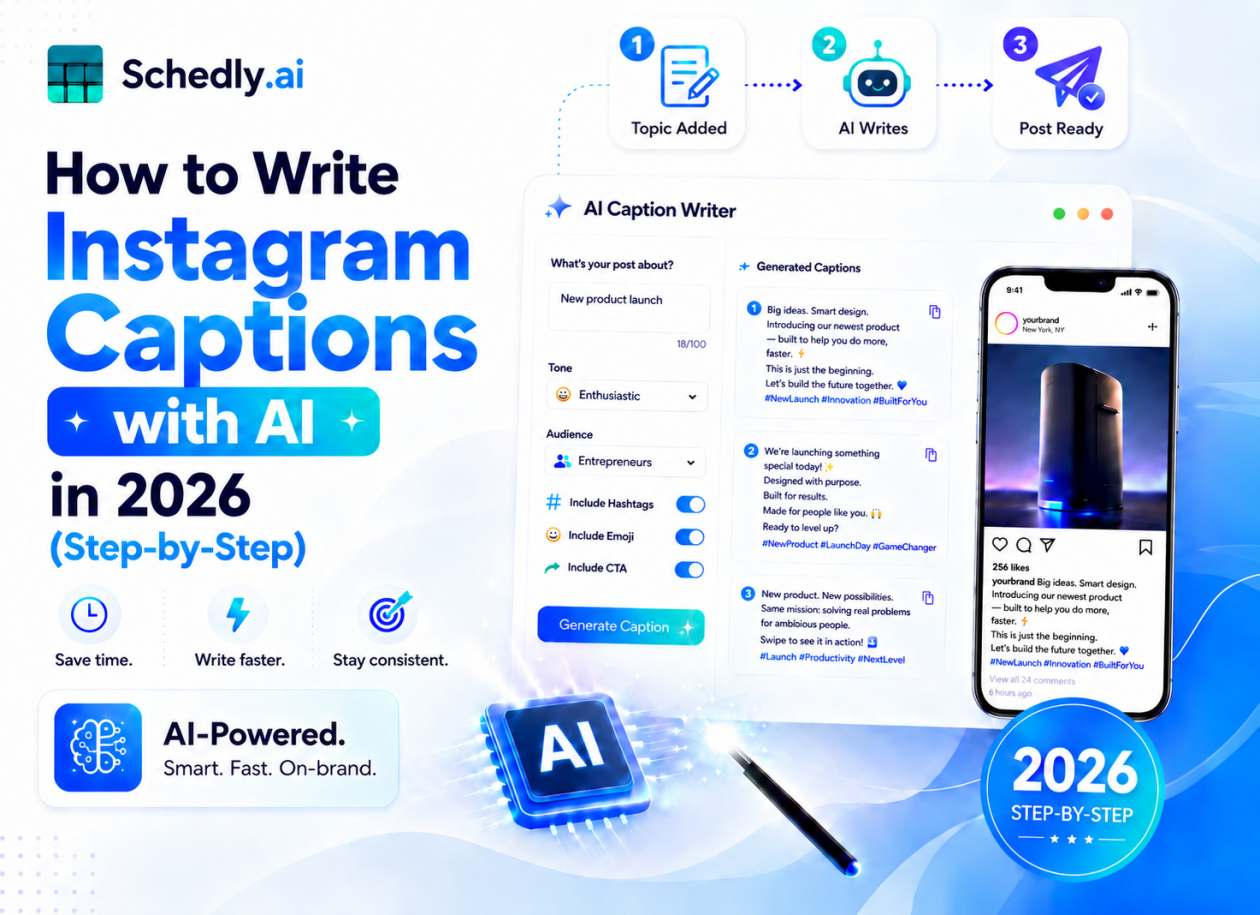
How to Write Instagram Captions with AI in 2026 (Step-by-Step)
The single biggest objection to AI-written captions is the same one creators have been making for two years: "they sound like AI." And honestly, most of the time, that's true. Generic prompts produce generic captions, and Instagram users can spot them from three scrolls away — the empty hook, the awkwardly placed emoji, the call-to-action that reads like a sales script from 2019.
But that's a prompt problem, not an AI problem. When you learn how to feed an AI caption generator the right inputs, the output stops sounding like a chatbot and starts sounding like you on a good writing day. Here's the full breakdown — and if you want to try the technique in real time, Schedly's free AI caption assistant supports every framework in this guide.
Why AI Captions Fail (and What's Actually Happening)
When you type "write me an Instagram caption about coffee" into an AI tool, the model has nothing to work with except the most statistically average coffee caption it has ever seen. It defaults to clichés because that's all you gave it. The fix isn't to abandon AI — it's to give the AI more context than your audience can detect.
A caption that sounds human has three layers: a hook tuned to your specific audience, a body that carries a real point of view, and a CTA that matches your actual goal. Most AI tools can produce all three if you ask correctly.
The 5-Part Prompt Framework
Every great AI caption starts with the same prompt structure. Memorize this once and you'll never write a flat caption again.
1. Topic — What is this post actually about? Be specific. Not "fitness" but "why I stopped doing fasted cardio after 6 months of testing."
2. Audience — Who are you talking to? "Women 28–40 who lift weights and care about science-backed advice" is infinitely better than "fitness enthusiasts."
3. Tone — Direct, playful, sarcastic, warm, expert? Pick two adjectives max. If you can't define your tone, your AI can't replicate it.
4. Goal — Are you trying to drive saves, comments, profile visits, link clicks, or just brand awareness? Each goal needs a different caption structure. Instagram itself confirms in its official Creator Lab guides that saves and shares are now the strongest distribution signals.
5. Constraints — Length (under 125 characters or full long-form), emoji density, whether to include a question, and any phrases you absolutely refuse to use ("Are you ready to level up?").
Feed all five into your AI prompt and the output quality jumps by an order of magnitude.
Hook Formulas That Actually Work in 2026
The first line of an Instagram caption is the only line most users read. According to data from Later, if your hook doesn't earn the tap on "more," the rest of the caption is invisible to 80%+ of viewers. Train your AI to write hooks using these proven openers:
The contrarian take: "Everyone says X. They're wrong, and here's why."
The personal admission: "I made a $4,000 mistake last month. Here's what it taught me."
The specific result: "Three changes that took my engagement from 1.2% to 4.8% in six weeks."
The counterintuitive question: "What if posting less actually grew your account faster?"
Avoid hooks that begin with rhetorical questions like "Have you ever wondered…" — they're the calling card of low-effort AI content.
The Body: Where Your Voice Lives
Once the hook earns the click, the body has to deliver. The mistake most people make is asking AI to write the entire body in one go. Instead, ask it to produce three different versions of the body section, each with a different angle: story-driven, list-driven, and contrarian. Pick the one closest to your voice, then rewrite the parts that don't sound like you.
This hybrid approach — AI for the skeleton, human for the soul — is what separates captions that get 200 saves from captions that get ignored.
Hashtags: Let AI Do the Heavy Lifting
Hashtag research is the single most overrated manual task in social media. A modern AI hashtag generator can scan trending tags in your niche, balance high-volume and low-volume tags for discoverability, and output 10 to 15 hashtags in two seconds. Spending 20 minutes hunting hashtags in Instagram's search bar in 2026 is, frankly, indefensible.
What you should do is review the AI's output. Kill any hashtag that doesn't match your specific post (irrelevance hurts the algorithm — Instagram's Adam Mosseri has confirmed this multiple times). Keep a mix of small (under 50K posts), medium (100K–500K), and large (1M+) tags so you have a realistic shot at ranking somewhere.
CTAs That Don't Sound Desperate
The final line of your caption is the lever that decides what users do next. Stop letting AI write "Double-tap if you agree!" by default. Specify the CTA goal in your prompt: "End with a question that invites a personal story in the comments," or "End with a soft CTA to save the post for later."
A great CTA feels like a natural continuation of the conversation, not a demand for engagement. AI can write these if you tell it that's what you want.
Real Example: Before vs. After
Generic AI caption: "Coffee is life ☕ Who else can't start their day without it? Drop a ☕ in the comments if you agree! #coffee #coffeelover #morningvibes"
Caption with the full prompt framework: "I switched to decaf six weeks ago, and I'm not the same person. My anxiety dropped, my sleep deepened, and I stopped white-knuckling my mornings. If you've been telling yourself you 'need' caffeine to function, this is your sign to test the opposite for a week. What's the one habit you've been afraid to break? #decafclub #anxietyrecovery #morningroutine"
Same AI tool, same topic. The second one earns saves and comments because it has a perspective, a story, and a question that invites a real answer.
Avoiding the Common AI Tells
There are three phrases that scream "AI wrote this" in 2026 — eliminate them from every caption.
First: "In today's fast-paced world." Nothing about your post is happening in any other kind of world.
Second: "Let's dive in." Captions don't have introductions. Get to the point.
Third: Lists of three adjectives separated by commas (e.g., "fresh, bold, exciting"). This is the AI's autopilot, and it never sounds natural.
If you see any of these in the output, regenerate or rewrite by hand. For more on detecting AI patterns, HubSpot's content guide has a longer list of red flags worth bookmarking.
Workflow: How to Caption a Week in 15 Minutes
Open your scheduling tool. Upload your seven visuals for the week. For each one, fill in the 5-part prompt (topic, audience, tone, goal, constraints) and generate three caption options. Pick the closest match, edit for voice, attach hashtags, and move on. Average time per caption: 90 seconds.
A week of captions that used to take three hours is done before your second coffee. If you want to see this exact workflow inside a real scheduling dashboard, check the Schedly demo video or read more breakdowns on the Schedly blog.
Final Thought
AI doesn't write captions for you. It writes drafts you finish. The creators who treat it that way produce more, post more consistently, and sound more like themselves over time — because they stop wasting energy on the blank-page problem and start spending it on the editing problem, where their actual voice lives.
The robotic caption era is ending. The hybrid caption era — fast AI drafts, sharp human edits — is what wins from here. Start a free trial of Schedly and put the 5-part framework to work tonight.
Share: