Best Times to Post on Social Media in 2026 (Data-Backed Guide)
If you've been told that posting time doesn't matter anymore because "the algorithm decides everything," that advice is half right and dangerously incomplete.
Yes, algorithms in 2026 are smarter than ever at distributing good content regardless of when it goes live.
But algorithms still rely on one critical signal to determine if your post is worth distributing at all: engagement velocity in the first 30 to 60 minutes after publishing.
Post when your audience is asleep and you starve the algorithm of that signal. Post when your audience is scrolling, and you give the algorithm everything it needs to push your content to more feeds. This guide breaks down what the latest data — from analyses of over 50 million posts — actually shows about the best posting times in 2026, platform by platform.
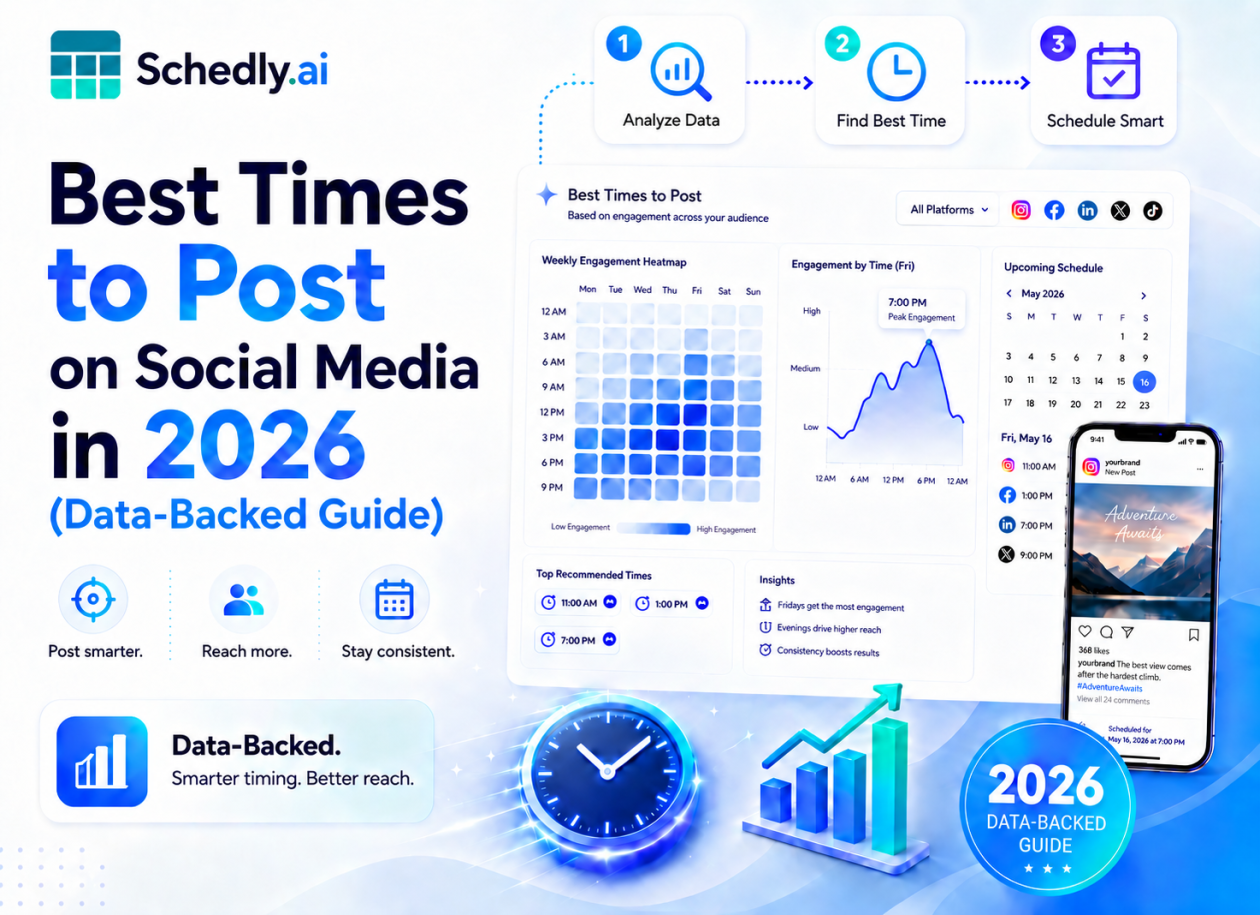
If you'd rather skip the manual research, Schedly's smart scheduler automatically suggests the best time for every post based on your specific audience.
Instagram: Mornings and Midweek Win
The 2026 consensus across Buffer, Later, Sprout Social, and SocialPilot points to two non-negotiable rules. The best times to post on Instagram in 2026 are Thursday at 9 a.m., Wednesday at 12 p.m., and Wednesday at 6 p.m., based on Buffer's analysis of 9.6 million posts. Later's analysis of over 6 million posts also confirms that early morning windows — specifically 3 a.m. to 6 a.m. — produced higher-than-average engagement across the board, likely because users see fresh content during their first morning scroll.
For Reels specifically, the data shifts. Posting between 8 a.m. and noon Monday through Friday consistently drives the highest watch-time and shares. Saturdays are the worst day across nearly every Instagram content type, and the algorithm's "sends per reach" signal — how often people DM your post to a friend — is now the dominant ranking factor, which means posting when your audience is actively chatting matters more than ever.
TikTok: Evenings and the Sunday Surprise
TikTok behaves nothing like Instagram. The platform's For You Page distributes content over days, not hours, but initial velocity still matters. The best windows in 2026 cluster around 6 a.m. to 10 a.m. and 7 p.m. to 11 p.m. local time. Tuesday, Thursday, and Friday produce the strongest performance for most niches, but a counterintuitive trend has emerged: Sunday evenings between 7 p.m. and 9 p.m. are quietly outperforming weekday primetime for entertainment-focused accounts, as users settle in for relaxed scrolling before the work week.
If you're in lifestyle, comedy, or pop-culture content, test Sunday nights. If you're in B2B or finance, stay weekday-focused. TikTok's own Creator Center publishes regional engagement data that's worth cross-referencing with your own analytics.
LinkedIn: Professional Hours, with a Twist
LinkedIn's audience is on the clock, and the data reflects that. Tuesday through Thursday between 8 a.m. and 10 a.m. local time is the platform's gold standard window — users checking their feed before meetings, on commutes, or with morning coffee.
A second smaller peak occurs at lunch, around 12 p.m. to 1 p.m.
The twist nobody talks about: LinkedIn content has a much longer half-life than other platforms. A post that goes up Tuesday morning can keep gaining traction through Thursday. That means posting frequency on LinkedIn matters less than on Instagram or TikTok — three to four high-quality posts per week consistently outperforms daily low-effort posts.
Avoid Friday afternoons, Saturdays, and Sundays entirely. LinkedIn engagement on weekends drops by roughly 60% compared to weekdays.
Facebook: Late Morning and Early Afternoon
Facebook's audience skews slightly older and uses the platform during work breaks. The strongest windows in 2026 are weekdays between 9 a.m. and 1 p.m., with a peak around 10 a.m. to 11 a.m. Wednesday remains the highest-engagement day, followed by Tuesday and Thursday.
Facebook also benefits from a phenomenon other platforms don't: sustained engagement on Sundays. Users browsing leisurely on Sunday afternoons engage with longer-form posts, video, and community content at notably higher rates. If your Facebook strategy includes group posts or video, Sunday between 1 p.m. and 4 p.m. is underrated. Meta's Business resource hub regularly updates audience-behavior reports worth following.
X (Twitter): Real-Time Rules
X is the most posting-time-sensitive platform because content half-life is measured in minutes, not hours. The best windows in 2026 are 8 a.m. to 10 a.m. and 6 p.m. to 9 p.m. on weekdays. Monday and Tuesday tend to outperform later in the week, partly because the news cycle is densest at the start of the work week.
The unique X rule: post frequency matters more than perfect timing.
Accounts posting four to six times per day consistently outperform accounts that post once perfectly. Replies, quote tweets, and threads count as posts here — you don't need to write four original tweets daily, just stay active.
Threads: The Wild Card
Threads' algorithm in 2026 still rewards experimentation over optimization, which makes timing advice harder to pin down. Early data suggests evenings between 7 p.m. and 11 p.m. produce the best engagement, with weekends performing surprisingly well — Threads users seem to treat the platform as their "wind-down" feed.
The biggest Threads insight isn't about timing, it's about cadence. Posting two to three times per day, mixing original posts with replies on bigger accounts, drives faster follower growth than perfect timing alone.
YouTube Shorts: Friday and Saturday Evenings
YouTube Shorts behaves more like long-form YouTube than like TikTok. The best windows are Friday evenings (5 p.m. to 9 p.m.) and Saturday afternoons (12 p.m. to 4 p.m.). Weekday performance is strong but more spread out, with no clear single peak hour. Tuesday and Wednesday at 3 p.m. are common secondary windows.
Shorts also benefit from upload consistency more than perfect timing — daily uploads at roughly the same time train both the algorithm and your audience.
Telegram and Broadcast-Style Channels: Evening and Weekend Heavy
Broadcast-style platforms like Telegram channels skew heavily toward evening engagement, with peaks between 8 p.m. and 11 p.m. and unusually strong weekend activity. Treat Telegram less like a feed and more like a newsletter — your audience checks in deliberately, not casually, so timing matters less than the value of each individual post.
How to Find Your Personal Best Times
Generic data is the starting point, not the answer. Every account has a unique audience whose active hours might differ from the global average by three to four hours. The two-step process: pull your platform's native analytics (Instagram Insights, TikTok Analytics, LinkedIn dashboard) and note when your followers are most active. Then run a 14-day A/B test, posting half your content at the global best time and half at your audience's peak window. Whichever bucket wins, that's your real best time.
A good scheduling tool will automate this entire process. Schedly's Best Time Suggestion feature analyzes your posting history and audience activity to surface optimal slots for every platform automatically — no spreadsheet required.
The Single Most Important Rule
Posting at the perfect time matters far less than posting consistently at a good time. A consistent schedule trains the algorithm, trains your audience, and trains you. An account that posts every Tuesday and Thursday at 9 a.m. for six months will outperform an account that obsesses over the "perfect" hour every single day. Pick a window. Stick to it. Adjust quarterly based on data.
For deeper dives into individual platform strategy, browse the rest of the Schedly blog — there are dedicated guides for each network covered here.
Final Thought
The era of guessing your posting times is over. The data exists, the tools exist, and the algorithms reward you for using both. The only excuse left for posting whenever you remember to is that you haven't yet built the system. Build it once, and your engagement floor rises permanently. Try Schedly free for 30 days — no credit card required — and let the platform handle the timing math.
Share: